
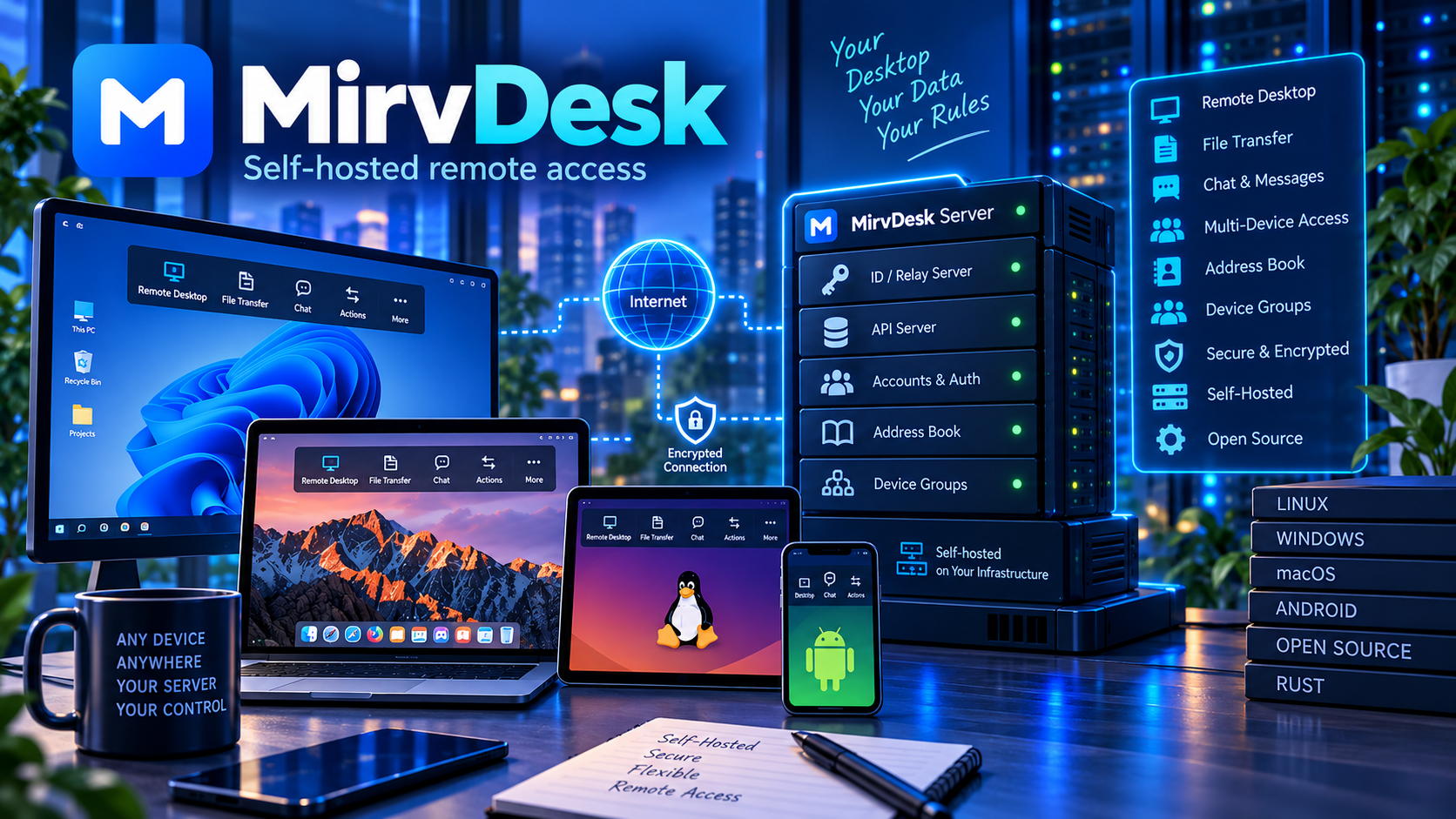
Self-hosted система удалённого доступа на базе RustDesk с собственной серверной частью, аккаунтами, адресной книгой и группами устройств.
MirvDesk сохраняет проверенный движок удалённого рабочего стола RustDesk, но отделён от оригинального клиента по внешней идентичности и рассчитан на собственную инфраструктуру. Клиент и RustDesk могут быть установлены одновременно: у MirvDesk отдельные конфигурация, службы, URI scheme, package IDs и имена пакетов.
Проект принципиально self-hosted: публичного сервера по умолчанию нет. Тот, кто собирает клиент, сначала поднимает собственный MirvDesk Server и задаёт MIRVDESK_SERVER_URL. Сервер предоставляет ID/relay, API, локальные аккаунты, персональные адресные книги и Accessible devices / Groups.
Основные возможности
- удалённый рабочий стол, передача файлов и TCP tunneling из upstream RustDesk;
- отдельная идентичность MirvDesk и совместная установка с оригинальным RustDesk;
- автоматическое обнаружение собственной серверной конфигурации через
/.well-known/mirvdesk; - локальные аккаунты MirvDesk Server и персональная синхронизируемая адресная книга;
- группы устройств и выдача пользователям доступа к группам;
- клиенты Windows, Linux, macOS и Android;
- Docker-сервер, включающий RustDesk Server OSS и API MirvDesk;
- обязательная привязка самостоятельно собранного клиента к собственному серверу — без fallback на чужую инфраструктуру.
Состояние проекта
Статус: активная разработка; актуальный публичный релиз клиента — 
Платформы: клиент — Windows, Linux, macOS, Android; сервер — Docker/Linux.
Технологии: Rust, Flutter/Dart, Go, SQLite, Docker, RustDesk Server OSS.
Лицензия: AGPL-3.0.
Ссылки
Релизы клиента · Клиент и документация · Сервер · Сообщить об ошибке
MirvDesk v1.7.8 is a self-hosted remote desktop client based on RustDesk. 1.7.8: Improve password visibility controls for account login and native administrator dialogs. The Show/Hide button is clearer and accessible by keyboard, and passwords remain masked by default. Resetting or creating accounts no longer requires entering an uninspectable password. 1.7.7: Fix duplicate Linux tray icons after login when MirvDesk and the desktop panel start at the same time. The client re-registers its existing indicator after the panel appears, allowing libayatana-appindicator to remove the leftover legacy icon. No system library changes are required. Legacy-only trays keep their existing behavior; panel restarts and menu actions were verified with an isolated GTK/D-Bus smoke test. 1.7.3: Automatic discovery of connected rendezvous device identities without account login; signed host-service heartbeats, verified online status, device display names, inventory search and All / My / Accessible scope views. Requires MirvDesk Server with device-registry-v1 support. Device presence and group visibility do not confer remote-control permissions. 1.7.2: Native administrator console added under Settings → Account → Manage users and devices for signed-in server administrators. Manage users (create/disable/password), groups, device group memberships, device notes and audit history. Requires MirvDesk Server 1.7.1 or newer with administrator API. Windows/Linux user-addressed connections remain available. 1.7.1: Addresses can target an OS user (ID\\username); Windows session selection, Linux logind discovery and session binding, and self-hosted-account UI improvements are included. True simultaneous remote streaming of independent Linux user sessions is NOT implemented yet. These features need real-device acceptance testing. Automatic updates: On Debian-based Linux, installed .deb packages include a systemd update timer which verifies SHA-256 release-asset digests and delays installation while remote sessions are active. Installed Windows clients check and update using their own GitHub release assets. Existing 1.6.x installs need 1.7.1 installed manually once before auto-update is available. macOS and Android updates still require explicit installation. Updates only come from github.com/mirivlad/mirvdesk-client; the upstream RustDesk updater stays disabled for MirvDesk. Builds require MIRVDESK_SERVER_URL pointing to your own server. MirvDesk deliberately ships with no default public server. CI packages cover Windows, Linux, macOS, and Android. MirvDesk v1.7.7 is a self-hosted remote desktop client based on RustDesk. 1.7.7: Fix duplicate Linux tray icons after login when MirvDesk and the desktop panel start at the same time. The client re-registers its existing indicator after the panel appears, allowing libayatana-appindicator to remove the leftover legacy icon. No system library changes are required. Legacy-only trays keep their existing behavior; panel restarts and menu actions were verified with an isolated GTK/D-Bus smoke test. 1.7.3: Automatic discovery of connected rendezvous device identities without account login; signed host-service heartbeats, verified online status, device display names, inventory search and All / My / Accessible scope views. Requires MirvDesk Server with device-registry-v1 support. Device presence and group visibility do not confer remote-control permissions. 1.7.2: Native administrator console added under Settings → Account → Manage users and devices for signed-in server administrators. Manage users (create/disable/password), groups, device group memberships, device notes and audit history. Requires MirvDesk Server 1.7.1 or newer with administrator API. Windows/Linux user-addressed connections remain available. 1.7.1: Addresses can target an OS user (ID\\username); Windows session selection, Linux logind discovery and session binding, and self-hosted-account UI improvements are included. True simultaneous remote streaming of independent Linux user sessions is NOT implemented yet. These features need real-device acceptance testing. Automatic updates: On Debian-based Linux, installed .deb packages include a systemd update timer which verifies SHA-256 release-asset digests and delays installation while remote sessions are active. Installed Windows clients check and update using their own GitHub release assets. Existing 1.6.x installs need 1.7.1 installed manually once before auto-update is available. macOS and Android updates still require explicit installation. Updates only come from github.com/mirivlad/mirvdesk-client; the upstream RustDesk updater stays disabled for MirvDesk. Builds require MIRVDESK_SERVER_URL pointing to your own server. MirvDesk deliberately ships with no default public server. CI packages cover Windows, Linux, macOS, and Android. MirvDesk v1.7.6 is a self-hosted remote desktop client based on RustDesk. 1.7.3: Automatic discovery of connected rendezvous device identities without account login; signed host-service heartbeats, verified online status, device display names, inventory search and All / My / Accessible scope views. Requires MirvDesk Server with device-registry-v1 support. Device presence and group visibility do not confer remote-control permissions. 1.7.2: Native administrator console added under Settings → Account → Manage users and devices for signed-in server administrators. Manage users (create/disable/password), groups, device group memberships, device notes and audit history. Requires MirvDesk Server 1.7.1 or newer with administrator API. Windows/Linux user-addressed connections remain available. 1.7.1: Addresses can target an OS user (ID\\username); Windows session selection, Linux logind discovery and session binding, and self-hosted-account UI improvements are included. True simultaneous remote streaming of independent Linux user sessions is NOT implemented yet. These features need real-device acceptance testing. Automatic updates: On Debian-based Linux, installed .deb packages include a systemd update timer which verifies SHA-256 release-asset digests and delays installation while remote sessions are active. Installed Windows clients check and update using their own GitHub release assets. Existing 1.6.x installs need 1.7.1 installed manually once before auto-update is available. macOS and Android updates still require explicit installation. Updates only come from github.com/mirivlad/mirvdesk-client; the upstream RustDesk updater stays disabled for MirvDesk. Builds require MIRVDESK_SERVER_URL pointing to your own server. MirvDesk deliberately ships with no default public server. CI packages cover Windows, Linux, macOS, and Android. MirvDesk v1.7.5 is a self-hosted remote desktop client based on RustDesk. 1.7.3: Automatic discovery of connected rendezvous device identities without account login; signed host-service heartbeats, verified online status, device display names, inventory search and All / My / Accessible scope views. Requires MirvDesk Server with device-registry-v1 support. Device presence and group visibility do not confer remote-control permissions. 1.7.2: Native administrator console added under Settings → Account → Manage users and devices for signed-in server administrators. Manage users (create/disable/password), groups, device group memberships, device notes and audit history. Requires MirvDesk Server 1.7.1 or newer with administrator API. Windows/Linux user-addressed connections remain available. 1.7.1: Addresses can target an OS user (ID\\username); Windows session selection, Linux logind discovery and session binding, and self-hosted-account UI improvements are included. True simultaneous remote streaming of independent Linux user sessions is NOT implemented yet. These features need real-device acceptance testing. Automatic updates: On Debian-based Linux, installed .deb packages include a systemd update timer which verifies SHA-256 release-asset digests and delays installation while remote sessions are active. Installed Windows clients check and update using their own GitHub release assets. Existing 1.6.x installs need 1.7.1 installed manually once before auto-update is available. macOS and Android updates still require explicit installation. Updates only come from github.com/mirivlad/mirvdesk-client; the upstream RustDesk updater stays disabled for MirvDesk. Builds require MIRVDESK_SERVER_URL pointing to your own server. MirvDesk deliberately ships with no default public server. CI packages cover Windows, Linux, macOS, and Android. MirvDesk v1.7.3 is a self-hosted remote desktop client based on RustDesk. 1.7.3: Automatic discovery of connected rendezvous device identities without account login; signed host-service heartbeats, verified online status, device display names, inventory search and All / My / Accessible scope views. Requires MirvDesk Server with device-registry-v1 support. Device presence and group visibility do not confer remote-control permissions. 1.7.2: Native administrator console added under Settings → Account → Manage users and devices for signed-in server administrators. Manage users (create/disable/password), groups, device group memberships, device notes and audit history. Requires MirvDesk Server 1.7.1 or newer with administrator API. Windows/Linux user-addressed connections remain available. 1.7.1: Addresses can target an OS user (ID\\username); Windows session selection, Linux logind discovery and session binding, and self-hosted-account UI improvements are included. True simultaneous remote streaming of independent Linux user sessions is NOT implemented yet. These features need real-device acceptance testing. Automatic updates: On Debian-based Linux, installed .deb packages include a systemd update timer which verifies SHA-256 release-asset digests and delays installation while remote sessions are active. Installed Windows clients check and update using their own GitHub release assets. Existing 1.6.x installs need 1.7.1 installed manually once before auto-update is available. macOS and Android updates still require explicit installation. Updates only come from github.com/mirivlad/mirvdesk-client; the upstream RustDesk updater stays disabled for MirvDesk. Builds require MIRVDESK_SERVER_URL pointing to your own server. MirvDesk deliberately ships with no default public server. CI packages cover Windows, Linux, macOS, and Android. MirvDesk v1.7.2 is a self-hosted remote desktop client based on RustDesk. 1.7.2: Native administrator console added under Settings → Account → Manage users and devices for signed-in server administrators. Manage users (create/disable/password), groups, device group memberships, device notes and audit history. Requires MirvDesk Server 1.7.1 or newer with administrator API. Windows/Linux user-addressed connections remain available. 1.7.1: Addresses can target an OS user (ID\\username); Windows session selection, Linux logind discovery and session binding, and self-hosted-account UI improvements are included. True simultaneous remote streaming of independent Linux user sessions is NOT implemented yet. These features need real-device acceptance testing. Automatic updates: On Debian-based Linux, installed .deb packages include a systemd update timer which verifies SHA-256 release-asset digests and delays installation while remote sessions are active. Installed Windows clients check and update using their own GitHub release assets. Existing 1.6.x installs need 1.7.1 installed manually once before auto-update is available. macOS and Android updates still require explicit installation. Updates only come from github.com/mirivlad/mirvdesk-client; the upstream RustDesk updater stays disabled for MirvDesk. Builds require MIRVDESK_SERVER_URL pointing to your own server. MirvDesk deliberately ships with no default public server. CI packages cover Windows, Linux, macOS, and Android. MirvDesk v1.7.1 is a self-hosted remote desktop client based on RustDesk. 1.7.1: Addresses can target an OS user (ID\\username); Windows session selection, Linux logind discovery and session binding, and self-hosted-account UI improvements are included. True simultaneous remote streaming of independent Linux user sessions is NOT implemented yet. These features need real-device acceptance testing. Automatic updates: On Debian-based Linux, installed .deb packages include a systemd update timer which verifies SHA-256 release-asset digests and delays installation while remote sessions are active. Installed Windows clients check and update using their own GitHub release assets. Existing 1.6.x installs need 1.7.1 installed manually once before auto-update is available. macOS and Android updates still require explicit installation. Updates only come from github.com/mirivlad/mirvdesk-client; the upstream RustDesk updater stays disabled for MirvDesk. Builds require MIRVDESK_SERVER_URL pointing to your own server. MirvDesk deliberately ships with no default public server. CI packages cover Windows, Linux, macOS, and Android. MirvDesk v1.7.0-3 is a self-hosted remote desktop client based on RustDesk. 1.7 preview: OS-user address suffixes (ID\\username), Windows session selection, Linux logind discovery and immutable session binding, plus self-hosted-account UI work. Full simultaneous multi-session Linux X11/Wayland streaming is still experimental and NOT implemented in this preview. Automatic updates: On Debian-based Linux, installed .deb packages include a systemd update timer which verifies SHA-256 release-asset digests and delays installation while remote sessions are active. Installed Windows clients check and update using their own GitHub release assets. Existing 1.6.x installs need this 1.7 preview installed once before the updater is available. macOS and Android updates still require explicit installation. Updates only come from github.com/mirivlad/mirvdesk-client; the upstream RustDesk updater stays disabled for MirvDesk. Builds require MIRVDESK_SERVER_URL pointing to your own server. MirvDesk deliberately ships with no default public server. CI packages cover Windows, Linux, macOS, and Android. MirvDesk v1.7.0-2 is a self-hosted remote desktop client based on RustDesk. 1.7 preview: OS-user address suffixes (ID\\username), Windows session selection, Linux logind discovery and immutable session binding, plus self-hosted-account UI work. Full simultaneous multi-session Linux X11/Wayland streaming is still experimental and NOT implemented in this preview. Automatic updates: On Debian-based Linux, installed .deb packages include a systemd update timer which verifies SHA-256 release-asset digests and delays installation while remote sessions are active. Installed Windows clients check and update using their own GitHub release assets. Existing 1.6.x installs need this 1.7 preview installed once before the updater is available. macOS and Android updates still require explicit installation. Updates only come from github.com/mirivlad/mirvdesk-client; the upstream RustDesk updater stays disabled for MirvDesk. Builds require MIRVDESK_SERVER_URL pointing to your own server. MirvDesk deliberately ships with no default public server. CI packages cover Windows, Linux, macOS, and Android. MirvDesk v1.7.0-1 is a self-hosted remote desktop client based on RustDesk. 1.7 preview: OS-user address suffixes (ID\\username), Windows session selection, Linux logind discovery and immutable session binding, plus self-hosted-account UI work. Full simultaneous multi-session Linux X11/Wayland streaming is still experimental and NOT implemented in this preview. Automatic updates: On Debian-based Linux, installed .deb packages include a systemd update timer which verifies SHA-256 release-asset digests and delays installation while remote sessions are active. Installed Windows clients check and update using their own GitHub release assets. Existing 1.6.x installs need this 1.7 preview installed once before the updater is available. macOS and Android updates still require explicit installation. Updates only come from github.com/mirivlad/mirvdesk-client; the upstream RustDesk updater stays disabled for MirvDesk. Builds require MIRVDESK_SERVER_URL pointing to your own server. MirvDesk deliberately ships with no default public server. CI packages cover Windows, Linux, macOS, and Android. Источник: GitHub Releases · данные кэшируются на сервере.
История релизов
v1.7.8 — MirvDesk v1.7.8
v1.7.7 — MirvDesk v1.7.7
v1.7.6 — MirvDesk v1.7.6
v1.7.5 — MirvDesk v1.7.5
v1.7.3 — MirvDesk v1.7.3
v1.7.2 — MirvDesk v1.7.2
v1.7.1 — MirvDesk v1.7.1
v1.7.0-3 — MirvDesk v1.7.0-3pre-release
v1.7.0-2 — MirvDesk v1.7.0-2pre-release
v1.7.0-1 — MirvDesk v1.7.0-1pre-release